
For those of you who are not familiar with Peshitta Primacy, it is the belief that the Syriac Peshitta (the Syriac Bible) is the original text of the New Testament. 1 It is a movement that first gained traction with the works of the late George Lamsa, and is primarily a position popularized by individuals within the growing Messianic Judaism movement in North America as well as some popular figures within the Assyrian Church of the East (Mar Eshai Shimun, etc.).
On its face, the Peshitta Primacy movement makes some seemingly compelling arguments that have to do with places where the Peshitta text displays interesting quirks of idiom (such as wordplay, puns, or ambiguous meanings) that the Greek text of the New Testament, as we have it today, misses or potentially mistranslates.
However, when taking a closer look things are not quite what they seem.
Problems With Time & Place
Classical Syriac, the dialect the Peshitta is written in, is the most prolific classical Aramaic dialect. It had a golden age between the 5th and 8th centuries and spread all over the Middle East to parts as far as India and China. In light of its history, what can the actual language of the Peshitta tell us about its character?
The Wrong Language
Many Peshitta Primacy advocates claim that the Peshitta dates back to the first few centuries AD. Since it’s written in Classical Syriac, and Syriac was spoken at that time, it seems logical that the text could be that old. The problem, however, is that not all Syriac is equal.
If the Peshitta was written right after Jesus’ lifetime, one would expect the dialect to match up with other inscriptions from the first few centuries. This particular dialect of Syriac is known as Old Syriac, 2 and is attested in about 80 different inscriptions. So when we compare the two what do we find are some very curious and telling differences.
All verbs in Aramaic start out as a “root” of (usually) 3 letters that express a particular concept. From there, prefixes, suffixes, and vowels are added to indicate the tense, person, number, gender, etc. of the verb and place it in context. For the “Perfect” (think of it roughly as the past tense) the defining feature is suffixes, where for the Imperfect (think of it roughly as the future tense) the defining feature is prefixes.
In Classical Syriac, to express the 3rd person masculine Imperfect (“he will X”) one adds on the prefix - /n-/. For example,
k-t-b
The verb “to write”
becomes
“He will write.”
This is one of the major defining features of the Classical Syriac dialect, it is ubiquitous and exclusively used in the Peshitta, and virtually every other dialect of Aramaic outside of the Syriac family makes use of a different prefix. For example, in Judean, Galilean, and Samaritan Aramaic that prefix is /y-/. For example:
k-t-b
The verb “to write”
becomes
So what is the significance of this prefix? The Syriac dialect, like other Aramaic dialects, originally used /y-/ for its Imperfect verbs. We have a large number of examples of this in the Old Syriac corpus:
From an inscription at Birecik Kalesi (6 AD) we find:
(he will see)
(he will praise)
(they will bow [to] him)
From an inscription at Serrîn (73 AD) we see:
(he will praise),
(they will bow [to] him),
(he will be) twice,
(“he will come”),
(he will perish),
(they will throw),
(they will find).
From an inscription at Sumatar Harbesi (~150 AD) we see:
(he will be) twice,
(he will judge), and
(he will give).
From an inscription at Sumatar (~150 AD) we find:
(he will perish), and
(he will be).
Each and every one of these examples makes use of /y-/.
It’s only until around the turn of the third century we start seeing examples of /n-/ in the Imperfect regularly mixed in with /y-/, and by about the 4th century it had completely replaced /y-/ as the preferred prefix with not a single further documented example. By the dawn of the golden age of Classical Syriac literature (around the 5th century) /y-/ was absolutely nowhere to be found.
In other words the Peshitta, at the earliest, represents fourth century Syriac.
It cannot be from the first or second centuries AD as some proponents claim.
Syriac Was Foreign in Galilee and Jerusalem
Since Syriac was such a prolific dialect, would Jesus have encountered Syriac where he taught and preached? As we’ve already established previously, if he were to come across it, it would have been Old Syriac. Where was Old Syriac spoken?
The kingdom-provence of Osroene, with Edessa as its capitol was some 350 miles to the north of Galilee and 400 miles from Jerusalem. It is this kingdom that was the cradle of the Syriac dialect and here it was primarily spoken.
Was it ever in Jerusalem or Galilee in the 1st century?
Yes it was. But as a novelty.
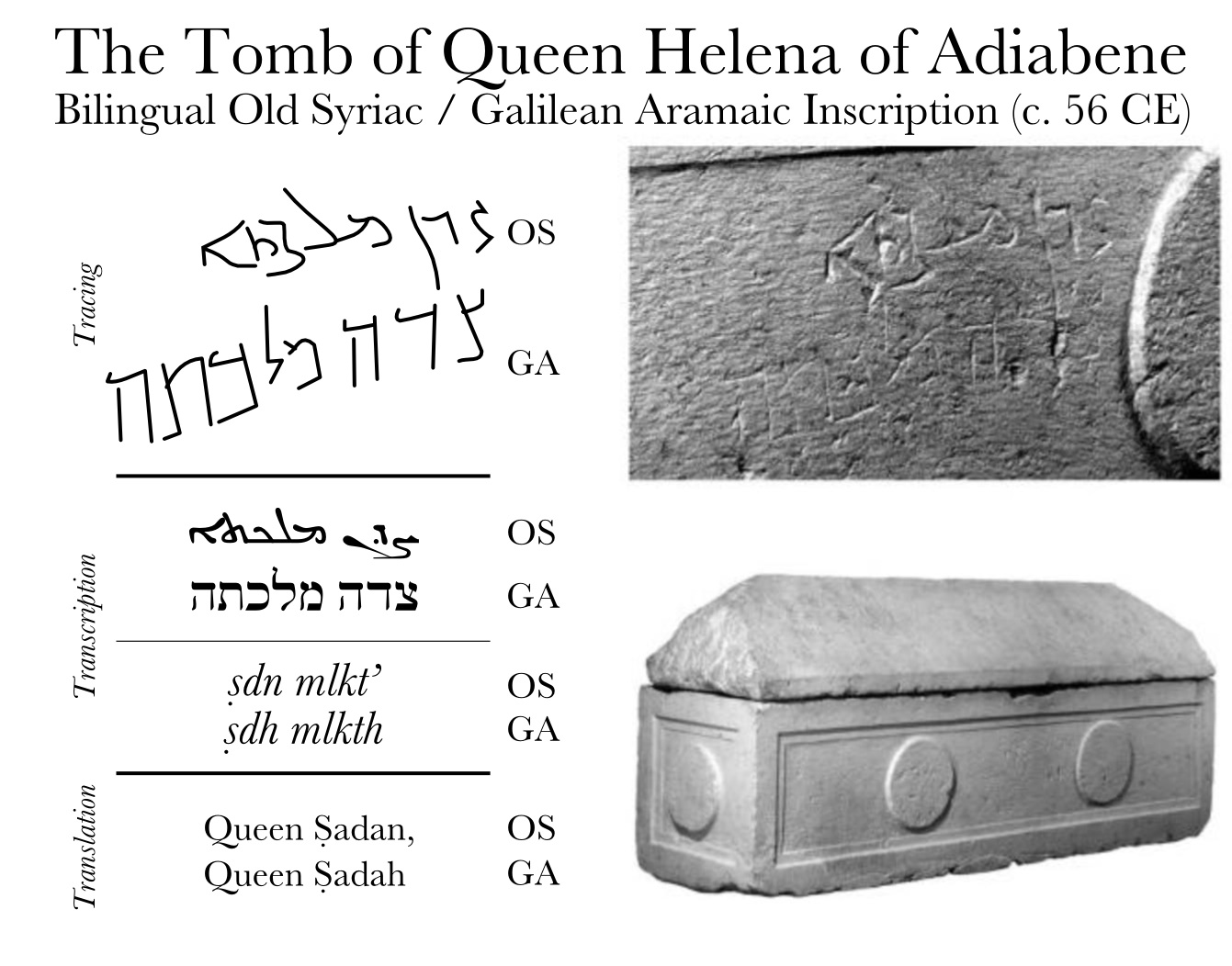
Out of all Aramaic inscriptions in Jerusalem in the 1st century, there is only one that was written in Syriac, on the Tomb of Queen Helena of Adiabene, a convert to Judaism, whose Jewish name was .
When she died around 56 CE and was buried, her name was carved into the side of her tomb in her native Old Syriac Aramaic. However, it seems that Old Syriac was such a problem to read, someone scratched in a translation (reforming the name in Western Aramaic orthography and phonology, rather than a straight transcription – this points to how certain final vowels were nazalized in Galilean) right below it in larger letters than the original inscription so that the common person could make it out.
Written Old Syriac proved difficult to understand among first century Jews.
The Peshitta’s Mistakes
Where those who promote Peshitta Primacy tend to emphasize that the Peshitta is perfect and unchanged, and this is partially true as it has a very strong manuscript transmission with few copyist errors. However, the core Peshitta text does make a number of mistakes. They are subtle, and one must look carefully to find them.
The Problem With “Rabbouli” 
In John 20:16, Jesus and Mary Magdalene have the following exchange:
Jesus said to her, “Mary.” She turned, and said to him, “Rabboni”; which is to say, “Teacher.”
In every Greek tradition we find something similar to:
λέγει αὐτῇ ὃ Ἰησοῦς Μαρία στραφεῖσα ἐκείνη λέγει αὐτῷ Ἑβραϊστί Ῥαββουνι ὁ λέγεται Διδάσκαλε
legei autê ho Iêsous Maria strafeisa ekeinê legei autô Hebra’isti Rabbouni ho legetai Didaskale
Jesus said to her, “Mary.” She turned and said to him in Hebrew, “Rabbouni” which means “Teacher.”
However in every manuscript of the Syriac Peshitta we puzzlingly find:
amar lah Yeshua Maryam w’ethpanayath w’amra’ leh `ebra’ith Rabuli d’methe’mar Malpana
Jesus said to her, “Mary” and she turned and said to him in Hebrew “Rabuli!” which is to say “Teacher.”
There is a discrepancy between the precise word that Mary spoke, as well as an odd accusation of its etymological origins. The Greek tradition says “Rabbouni” where the Peshitta tradition says “Rabbouli”. “Rabbouni” could easily come from rabuni which means “my teacher” or “my master” in Jewish dialects of Aramaic; however, “Rabouli” is not a common word at all. The only possibility is that it is a later Syriac word that means “head shepherd,” but the form “Rabouli” is not attested in any contemporary dialects to Jesus. It is not attested in Hebrew, either.
Second, they both claim that this word is “Hebrew,” rather than Aramaic. This is not so much of a problem in the Greek, as Ἑβραϊστί is commonly used to describe words of both Hebrew and Aramaic origins (in a sense it’s used as “the Jewish language”); however, in the Syriac Peshitta, it is only really used to describe Hebrew words, as Syriac itself is an Aramaic language. But, as we touched upon earlier, this is not a Hebrew word.
Things That Syriac Misses
Where Syriac is good on picking up puns and wordplay that exist in the Aramaic under-layers of the New Testament, it doesn’t catch them all. There are some wordplays completely missed due to the fact that Syriac is an Eastern dialect of Aramaic, where Galilean is a Western dialect. Between the two there are a large swath of lexical differences, and puns and wordplay depend heavily upon double-meanings that may be present in one dialect… but completely absent in another.
He Who Lives By The Sword
In Matthew 26:52 we have a scene where Jesus rebukes Peter for being rash:
Then said Jesus to him, Put up again your sword into his place: for all they that take the sword shall perish with the sword.
In the Greek New Testament, the bolded part above reads thus:
παντες γαρ οι λαβοντες μαχαιραν εν μαχαιρη απολουνται
pantes gar hoi labontes mahairan en mahairê apolountai
For all who did take a sword, by a sword they shall die.
And in the Peshitta it reads thus:
kulhun ger hānun da-nsab saife, b-saife n’muthun
For all of they who take up swords, with swords they shall die.
Note how the Peshitta renders “swords” (in the plural) rather than “sword.” This is very curious, because a plain retro-translation back into Galilean Aramaic reads:
bagin kal d-nsab saiyp, b-saiyp 3 yimuthun
For everyone who took up a sword, by a sword (OR “in the end”) they shall die.
In Western Aramaic dialects the word saiyp can mean either “sword” or “end.” Given the context, this wordplay is undoubtedly intentional, and the use of b-saiyp as “in the end” is well attested in Rabbinic literature. 4
The Greek, of course, misses this right off the bat. Furthermore, this double meaning does not occur in Syriac, or other Eastern dialects 5 from the era, so the Peshitta misses it completely, instead choosing to render both instances of saipa in the plural (which makes the pun impossible). This wordplay also does not occur in Hebrew.
Where this very wordplay is found, however, is in the Christian Palestinian Aramaic New Testament 6 and Lectionary 7, written in a Western dialect that is in many ways similar to Jesus’ own:
kol hāleyn d-nasvin saipa b-saipa āvdin
All those who take up the sword, by the sword (OR “in the end”) they shall be lost.
As such, the “original” version of Matthew cannot be from the Syriac Peshitta.
Mistaken Information
There are also a number of other arguments that are floating around on the Internet that claim that a number of textual errors can be resolved by looking at how the Peshitta renders a particular verse. Some of these seem rather compelling, but many are based upon mistakes, half truths, or outright fabrications.
Gavra – The Genealogy of Matthew
This argument is a common one among Peshitta advocates and plays upon a well known problem in the New Testament. In the first chapter of the Gospel of Matthew, the author lists a genealogy attributed to Jesus, providing a long list of names dating back to Adam. At the very end (in verse 17) it is summed up with the following:
So all the generations from Abraham to David are fourteen generations; and from David until the carrying away into Babylon are fourteen generations; and from the carrying away into Babylon unto Christ are fourteen generations.
However, there is a small problem that has beplagued textual scholars for many, many years: Matthew’s last set of 14 only has 13 generations.
| # | Set #1 | Set #2 | Set #3 |
|---|---|---|---|
| 1 | Abraham | Solomon | Salathiel |
| 2 | Isaac | Roboam | Zerubabel |
| 3 | Jacob | Abiyah | Abuid |
| 4 | Judas | Asa | Elachim |
| 5 | Phares | Jehosaphat | Azor |
| 6 | Esron | Joram | Sadoe |
| 7 | Aram | Ozias | Achim |
| 8 | Aminadab | Joatham | Eluid |
| 9 | Naason | Achaz | Eleazar |
| 10 | Salmon | Ezekiahs | Mathan |
| 11 | Booz | Manasses | Jacob |
| 12 | Obed | Amon | Joseph (the husband of Mary) |
| 13 | Jesse | Josias | Jesus |
| 14 | David | Jechonias | ??? |
Hundreds of theologians have spilled rivers of ink taking on this apparent “problem” trying to find different ways to harmonize it, but in the end, Matthew’s genealogy only has 13 actual generations in its last set rather than the 14 described.
Now within the Peshitta Primacy movement, the argument goes that in the Syriac Peshitta, the word for “husband” or gavrā can also mean “guardian,” and therefore the Joseph listed here is Mary’s father or legal guardian. This would make Mary the next generation on the list, and round out the third set of 14 evenly.
Unfortunately gavrā has no such meaning.
There is not a single ancient lexicographer in any dialect of Aramaic that attests to this, nor a single ancient Syriac-speaking theologian who brought this possibility up, nor a single modern lexicographer that attests to this meaning either. However, plenty of ancient sources attest to the fact that gavrā — in the relational context of a genealogy — exclusively means “husband” (just like the word ἄνδρα andra does in Greek).
Conclusion
It is true that many of the phenomena present in the Peshitta are due to the fact that the tradition they represent dates back to an Aramaic source that was translated and incorporated to the New Testament some time during its transmission. Since the Peshitta is in a dialect of Aramaic they come across more clearly than they do in the Greek simply by virtue of being an Aramaic language; however, this does not necessarily point to the Peshitta being the original.
When we look at the New Testament in light of the time period, we find places where the Peshitta doesn’t quite match. It is written in a language that is 200-300 years too young and whose ancestor was difficult for Jews in the 1st century to comprehend. When we look at the New Testament in light of Jesus’ own dialect (early Galilean Aramaic, a dialect quite different from Syriac), we can find places where such phenomena as wordplay, puns, and potential mistranslations exist that are not present in the Peshitta.
As a result, where Peshitta Primacy is very alluring, there are some serious errors that disqualify the Peshitta as the original autograph of the New Testament as we know it.
Notes:
- In contrast, most scholars conclude that the Peshitta is a ~4th century translation from the Greek and a revision of the prior Old Syriac tradition. ↩
- This is not to be confused with the dialect of the “Old Syriac” Gospels. They are in early Classical Syriac and are merely “Old” relative to the Peshitta. Aramaic nomenclature can sometimes be problematic due to points of reference. For example, one often refers to “Eastern” and “Western” Syriac, but both of these dialects are Eastern Aramaic languages. (They are merely “eastern” and “western” when compared to each-other.) ↩
- Or /b-sof/, same root. ↩
- For both /b-saiyp/ and /b-sop/: The Palestinian Talmud, Targum Neophyti, and others. ↩
- Both “Eastern” and “Western” Syriac are actually Eastern Aramaic dialects. Eastern and Western in their case are relative to each other rather than the Aramaic language family as a whole. ↩
- Although fragmentary. ↩
- Palestinian Syriac Lectionary of the Gospels (Lewis & Gibson 1899) ↩
Hye,
I’m not a specialist in late Aramaic, although I did study Biblical Aramaic, but it seems to me your transliteration has a few errors :
בגין כל דנסבון סייף בסייף נמותון
bagin kal d-nsab saiyf, b-saiyf yimuthun
Corrected :
בגין כל דנסבון סייף בסייף נמותון
bagin kal d-nsabun saiyf, b-saiyf yimuthun
for d-nsab the square script adds “un”
for yimuthin in the square script you have a nun, not a yod
cheers,
milta
Milta,
Thanks for catching that! It turns out that the transliteration is correct, where the transcription has the errors. Sadly that is one of the pitfalls of working with transliterations, mainly that when you make an edit or correction one needs to be sure to propagate that edit through all expressions of the same phrase. 🙂
Case and point with the correction (under “Corrected:”) you provided me with, there’s still a disparity between נמותון and yimuthun. 🙂
In any case, I’m going to completely re-do the text in this article with images and give them a careful once-over.
Thank you for your keen eyes!
-Steve
I just read Beth Mardutho’s article on the interpretation of “The Kingdom of God Is Inside You” (http://syrcom.cua.edu/Hugoye/Vol12No2/HV12N2Ramelli.pdf). Her analysis is based upon many things, one of which is a Peshitta translation (from Kiraz, 1996). Does her analysis seem reasonable to you?
Sorry, the author of the article was Ilaria Ramelli. (Beth Mardutho holds the copyright.) Also, there is a related blog post by Michael Marlowe (http://bible-researcher.blogspot.com/2011/11/kingdom-of-god-is-within-you.html).
Hello Sir Steve Caruso,
I can not agree with you
Very strong evidence, proof to the Peshitta primacy is there arguments:
-Peshitta is the most brief version od the New Testament, without several later addendums, additions
-linguistic uncertainties of Peshitta (it is very difficult to the translation) is evidence of Aramic primacy. (greek version compared with Peshitta is linguistic very clear)
See also this link:
http://en.wikipedia.org/wiki/Textual_criticism#New_Testament
Bohuslav,
Thanks for your comments. 🙂
In your opinion, then, how does the above (a missed pun and oral device that demonstrates that the Syriac of the Peshitta could not be original) fit into Peshitta Primacy?
Peace,
-Steve
Steve,
I think, the verse “Matthew 26:52” is evidence to Peschitta Primacy too.
In this verse (Matthew 26:52) has Peshitta 14 words and Greek translation 21 words. Greek translators, scribes add 7 words.
And added words in later Greek translated version is not only this one verse. There are dozens or hundreds verses in New Testament. This is very clear evidence to Aramic Primacy!
And Greek scribes dont add only words, but also full group verses – for example John 8:1 – John 8:11 (Greek scribes promote the prostitution).
Bohuslav,
Very few languages have 1:1 parity with the number of words to express a concept. With simple sentences, Aramaic tends to be more compact word-wise compared to Greek as in Aramaic things like personal pronouns and different prepositions tend to be prefixes and suffixes where in Greek they are separate words. As such, I’m not sure that this can be construed as evidence of originality in either direction.
Also, many early Greek manuscripts make the same omissions as the Peshitta, and there are several places in the Peshitta where there are additions that are not represented in other traditions. For example, the Pericope of the Woman Caught in Adultery (John 8:1-11) is actually absent in many early Greek manuscripts, and in other manuscript families it shows up in different places (in some it even shows up in Luke), so it’s certainly a later addition. The Peshitta, like some Greek manuscripts, simply omits it. So, this is not evidence for originality in either direction, either.
My question is: If the Peshitta is shown to miss a wordplay or pun that can be traced back to Jesus’ dialect of Aramaic, and the Greek portrays a direct translation of that pun, rather than a direct translation of the Peshitta, how can the Peshitta be the “original”?
In short, it is impossible. The Greek here could not have come from the Peshitta, nor could the Peshitta’s rendition of the verse be taken from it’s original form.
My question is, how does *that* fit in with your concept of Peshitta Primacy?
Peace,
-Steve
Steve, you are great man. I think you are probably the best expert in Aramic dialects, I admire you, you are very wise 🙂
But verse Matthew 26:52 has very small difference (negligible difference). Exist larger differences between Greek NT and Peshitta.
Matthew 26:52 is only one of hundreds verses which support Aramaic Primacy. It is my personal view
*********
In the Indoeuropean Languages (that is Greek too) is very important gramatical case (in nouns and pronouns).
English is exception, is very simple language, English dont use gramatical cases (shape of gramatical case is replaced through prepositions).
Is right – Aramaic use often “double words”,
but in Greek language (if we make translation from Aramaic to Greek) we can very often preposition replace with gramatical case (we make translation without preposition).
Greek language use less words than Aramaic in a lot of sentences and phrases
Generaly, I think: Aramaic language use the same or more words in phrases and sentences than Greek language.
In the Greek New Testament is more words (when we dont count the Strong Number 3588 too) than in Peshitta. That is evidence to Peshitta primacy.
Greek translators of Peshitta (in 3.-4. century) added more words for better intelligibility.
*******
Etheridge, Lamsa, Mudrock, Younan, Roth, Bauscher that are swindlers. Their translations are praktical the same as Greek version. Peshitta and Greek version have big differences.
http://interlinearbible.org/matthew/26-52.htm
http://www.dukhrana.com/peshitta/analyze_verse.php?lang=en&verse=Matthew+26:52&source=khabouris&font=Estrangelo+Edessa&size=150%
“The missed pun” may be purely presupposition. Not all sentences would have these constructions (even in the original) and if you are recreating a previously unknown, or non-extant text that happens, or seems to create a pun, then isn’t it possible there never was a pun in this instance? After all, I can think of a lot of English sentence constructions wherein I can originate rhyme, word play or create pentameter prose or poetry with. The construction of word play is not necessarily proof of original authorship or style. If a reading is original, why would there be no extant offspring in the original language? This would elevate recreated or presumed textual readings above existing evidence, wouldn’t it?
It is untenable to me that the Legates of the Yeshua would autograph original works in anything but the language they spoke in. Perhaps you are correct that the copies of the Peshitta are a newer language than what was spoken by Messiah, but it would appear they are the best physical representations in existence in manuscript form, if one believe in an Aramaic original. Otherwise, we seem to be stuck with recreated, non extant readings with little to no underlying New Testament Documents which contain the “exact” readings we recreate.
As explained elsewhere on my website, everything I am doing here is a matter of plain-reading reconstruction into the very dialect that you believe the original autographs must be written in. It is not a perfect process (nor do I ever claim it to be) but it yields insights that cannot be garnered from the Peshitta, since the Peshitta’s dialect is not just a “newer language,” but a very different dialect in many respects pertaining to vocabulary, grammar, etc..
To think about it, the Peshitta is, itself, a *translation*. My work is no “worse” than that, nor the Peshitta somehow “better.” And where I do pull from the Peshitta on occasion (as an Aramaic language source, it is useful) I also pull from the fragments that survive of the Christian Palestinian Aramaic New Testament (which *is* a source contemporary to the Peshitta, written in a dialect an order of magnitude closer to Jesus’ own) and the Galilean corpus of rabbinic work (i.e. the same dialect as Jesus’) itself.
If you’re looking for “exactness” of any variety, it is neither in the Peshitta, nor my own work. If you’re looking for a deeper understanding of the New Testament in Jesus’ own language and dialect, my work is – by design – “closer” than the Peshitta is.
Peace,
-Steve
I just realized you wrote the Aramaic words from right to left. I was wondering why you call them prefixes and The Lord helped me figure it out. Just like the Hebrew, right?
What about Lamsas crazy myth in his own translation where he makes up the argument that Matthew 19:24 the aramaic word “rope” was mistranslated to “camel” in the greek manuscripts.
Matthew 19:24And again I say unto you, It is easier for a camel to go through the eye of a needle, than for a rich man to enter into the kingdom of God.
Can you prove him right or wrong, many peshitta primacists live on this one argument.
Henry,
The thing is that Lamsa is right that in Classical Syriac גמל does mean both “rope” and “camel” – but with the *huge* caveat that the idiom simply did not exist in the first century.
Despite thousands of examples from antiquity, the very first recorded instance of גמל meaning “rope” is found in the 10th century in the Syriac-Arabic dictionary of Bar Bahlul. This is about 1,000 years after Jesus’ time on earth and only in Syriac and Syriac-influenced dialects. In *non*-Syriac dialects of Aramaic (especially the various Jewish dialects that survived) there is zero evidence for this double meaning at all, both ancient and modern.
Additionally, the exact same saying appears in the Talmud (Bavli, Berakhot 55b) but instead of a camel we find an elephant. No puns in this case present themselves.
Peace,
-Steve
Earlier Peshitta manuscripts were destroyed by the Muslims. However, we have Aramaic manuscripts that date to the 4th or 5th centuries. I think it’s possible that the Aramaic Peshitta text was updated with the nun (n) in the place of the yod (y). That would mean that the Aramaic Peshitta text is still the original NT. The Greek NT also went through a letter change of all capital Greek letters (uncial script) to upper and lower case Greek letters (classical & modern script). Nevertheless, the Greek NT can’t be the original. It has too many errors. Many of those errors can be seen as translation blunders from the Aramaic text. – P.S. The Aramaic NT is translating the meaning of a Hebrew word or words. Rabuli “my great one” or “my teacher” appears only one time in the Aramaic Bible & represents the Hebrew word Raboni “my [great] Master” or “my high Rabi.”
We have no evidence of earlier Peshitta manuscripts, though. Only so-called “Old Syriac” manuscripts (which are in Classical Syriac, just linguistically older than the Peshitta) and translations of the Diatessaron. The earliest actual Peshitta manuscript we have is from the late 5th century or early 6th (Codex Phillipps) which has a very large number of Old Syriac Gospel readings in it.
So it’s not *just* a matter of switching a nun for a yod. There are vocabulary and grammatical differences that firmly date the standard Peshitta’s text to no earlier than the 4th-5th century – and that is despite zero examples of the standardized Peshitta text until a few hundred years later.
The Greek having “too many errors” is a tricky claim to make, as it *is* in a contemporary dialect of Greek (i.e. we know it existed in the 1st century; we have many examples of that dialect), and the fact that Koine is vulgar (that is to say, common Greek, not literary greek).
The problem with “Rabuli” is that it is *not* an Aramaic word. It appears neither in Hebrew, nor in any Aramaic dialect other than Syriac – which is not what Jesus and his followers spoke. It’s a one-way transcriptional blunder that is reproduced in every copy of the Peshitta found to date and as a result is a significant problem for the Peshitta’ primacy.
Peace,
-Steve
@ SteveCaruso:
Rabuli is an Aramaic word. It appears in my Compendious Syriac Dictionary and in the Peshitta text. Rabuli is from the Aramaic words: raba “great one, teacher” and li “to me,” and hence means “my great teacher.” It only appears one time in the whole Aramaic Bible. It isn’t a common Aramaic word & hence the need for a translation. The pattern that the Peshitta NT displays is that it will say something is in Hebrew but the text is a translation of the meaning of the Hebrew words. The following are a couple of examples. “Beth Khisda “place of kindness (mercy) [John 5:2]” are Aramaic words that represent the words & meaning of the Hebrew words Beth Khesed. In the Crawford Aramaic text of Revelation, Satan is said to have the Hebrew name aw-du “servitude, service” (Rev. 9:11). Aw-du is the shortened form of aw-du-tha & again is an Aramaic word; not Hebrew. What John did is he has translated the meaning of the Hebrew word av-don “servitude, service.” And hence aw-du represents the Hebrew word av-don. The Aramaic words chosen to represent Hebrew words generally share the same Semitic root & are not common Aramaic words.
No, it’s really not, and the fact that they’re so “not common” is one of the biggest problems. With rabbouli, for example, the very first place it shows up is in the 5th century with the Peshitta as a poor transliteration of the Greek. It’s not a matter of being uncommon, it’s a neologism at that point. Brand new. 🙂 The Compendious is listing later folk etymology as compounds don’t work that way in Syriac. 🙂
And places like Beth Khesda are problematic in Syriac, as hesda means “curse” not “blessing” as it does in Jesus’ own dialect – and similar problems exist with the other poor transliterations of well-understood words.
Peace,
-Steve
@SteveCaruso – “Khisda” is an Aramaic word that means “kindness, mercy.” Khisda is rarely but sometimes used as the translation for the Hebrew word khesed. It appears a good amount of times in the OT though. I know I’ve seen that word in Genesis, Chronicles & Sira. Here are some places where Khisda can be found in the Peshitta OT: (1 Chron. 19:2; 2 Chron. 1:8; Sira 50:26; 51:11; etc.
@ Stevecaruso
Sorry about the delay but I have been reading many Samaritan, Assyrian, Babylonian, etc Aramaic texts from the 1st – 3rd centuries on the Comprehensive Aramaic Lexicon (CAL) website. The script is the square Aramaic or Hebrew font. The yod is used for the future tense of the verb. However, the grammar is the same as the Estrangela script in regards to conjugating the verbs and word spellings. So my original deduction that the Aramaic script was just changed remains a valid argument. It would have been a simple process & the original text would have been preserved. – Note: The Hebrew script was also changed around 5 BC. That doesn’t mean that the Hebrew OT only dates to that time period. That is however just the start of the different Hebrew script. You probably already know this but ancient Hebrew letters were pictures of different things like a ox head, staff, water, eye, basket, etc.
You’re confusing superficial morphological features with grammatical features. For example, can you explain to me the differences that exist between the use of the verb אית/ܐܝܬ in Syriac and Galilean? Or how the use of the Active Participle differs and what modern English tenses they match up with under each dialect? 🙂
Letters don’t “just change” unless the spoken language changes.
Peace,
-Steve
@SteveCaruso
The Peshitta solves the problem of the missing name in Matthew chapter one. The Aramaic verb i-lidh (he begot, fathered) is in the causitive Apel form as aw-lidh (he caused to be born, fathered). Sometimes this word has a more broader meaning. Most of the time in Matthew chapter 1 it means “to father” as in Awraham fathered Yiẓkhaq (Isaac) [Matt. 1:2]. However, at verse 11, the text should be translated as “Yoshiyah caused Yeconiah to be born.” If you follow the Biblical genealogies, you would find out that Yoshiyah actually fathered YEHOYAQIM & YEHOYAQIM fathered Yeconyah. So YEHOYAQIM is the missing name in the genealogy. The 1st group is from Awraham to David, the 2nd group from Shelomoh (Solomon) to YEHOYAQIM, & the 3rd group is from Yeconyah to Yeshua. I can see how the Greek translation got it’s wrong translation from the Aramaic. So the Greek NT is wrong here while the Aramaic text is correct or flawless. Paul said to study to show ourselves approved (2 Tim. 2:15). Christians can’t leave out the studying.
The Aramaic text could support the meaning you put forth here on this website at Matt. 26:52, by adding the words [in the end] or [eventually] in the translation. That statement would then read: “…return the sword to its place (sheath), for all of those who take up the sword[s] shall die [in the end] by the sword[s].” Otherwise, I prefer the word “eventually” & that statement would thus read: “…return the sword to its place (sheath), for all of those who take up the sword[s] shall [eventually] die by the sword[s].” The word “sword” is likely plural because the second part refers to a plural of people by the use of the pronoun “those.” However, that doesn’t mean that each person has more than one sword. Say-pa (sword) is spelled the same way in its singular & plural meaning & hence this would explain the Greek rendering & as a side note, may be singular like the Greek rendering. Whether this word has the singular or plural meaning, & I prefer the plural pointing, the message is the same. Each person would likely just have one sword. – Yeshua wouldn’t be using a word play in this statement b/c Aramaic doesn’t have the word “end” that shares the same Aramaic root of “sword” like Hebrew does.
Treating the Causative in the way you do is to make the etymological fallacy. “Caused to be born” in the way you describe it and in the context of a genealogy such as this is assuming the conclusion and shoehorning the meaning to fit. It means “to beget” or “to produce” and to decide that it suddenly means something else after how many repeated examples makes no sense.
There is no implied “eventually” with b’saif and the number of the verb does not support your assertion – and even in Old Syriac script we would have seen a seyame if there was a plural.
And the dual meaning of “end” and “sword” *is* attested in Western Aramaic, not in Syriac.
Peace,
-Steve
@ SteveCaruso
Aw-lidh or maw-lidh can be seen to mean “caused to be born” or “causing to be born at (2 Kings 20:18; Jer. 16:3; Eze. 47:22; etc.).
The Peshitta text obviously has Yeshua saying sword[s] every time in that verse . However, Saypa (sword) without the second letter yod would spell the Aramaic word spa (end) [2 Kings 21:16].
Are you able to update a couple of my previous posts to show my acronym name instead of my first & last name; then delete this last line?
My friend, you’re falling victim to an ambiguous, poor choice of English gloss. The word ܣܦܐ /səppā/ means “end” in the sense of *dimensions,* not “end” as in the sense of temporality or mortality. It’s usually translated “edge” or “border” or “threshold” to avoid this ambiguity (“edge to edge” in 2 Kings). The pun I’ve outlined cannot work with it.
The system is going to show the username you signed up with in the comments. It shouldn’t be showing your full name.
Peace,
-Steve
Thanks for the article Steve.
I was wondering about something at the beginning of the article: When you say the Peshitta NT is the wrong language because the dialect is from a later period than the time of Yeshua and the apostles, but wouldn’t it be more accurate to say it’s the “wrong dialect” instead? “Wrong language” seems to overstate the difference, no?
Regards,
Erik
Good question, Erik.
It’s a matter of tradition to refer to different “dialects” of Aramaic, rather than different “languages” – but it’s a tradition that is changing in academia. Max Weinreich, the famous Yiddish scholar, when discussing the matter of dialect vs language remarked, “A language is a dialect with an army and navy.” In this case a more useful metric as to Aramaic’s cohesiveness is the fact that it is certainly not one monolithic mutually intelligible language. Many of the “dialects” are as disparate as the Romance Languages as they drifted away from Latin (which is a similar process that Aramaic underwent with the fall of the Persian Empire).
In truth, Classical Syriac and Galilean are very distinct. They are from different eras and cultures, have unique grammatical tenses that the other does not use (or uses very different), and vocabulary is distinct (and meanings for the same roots have drifted apart). They use separate alphabets, separate definite state systems, separate vocalization systems, different common words such as pronouns and prepositions, and pronunciation of the words shared in common was very, very different. On paper and transcribed, those differences can be reduced by looking at etymology and commonalities, but in many ways at their *closest* (and that was Old Syriac to Galilean, not Classical Syriac) they were like Spanish is to Portuguese – and those are certainly two separate languages.
As such “wrong language” I believe is the most appropriate distinction.
Peace,
-S